Showing posts with label Challenge Based Learning. Show all posts

Monday, August 1, 2016

The Need Challenge Based Learning (CBL)

   When I began using CBL with my students back in 2009 I knew it was a framework that we could use to cover the Florida Framework for K-12 Gifted Learners well, but it has also brought something else into light for both my students and myself. Within the CBL framework students are called to work hard to fully understand an issue completely before coming up with a solution, but when we look around the world today that is not what we are seeing. It seems like with so many issues we watch people take polarizing sides (sometimes aggressively) without truly understand the issue as a whole. 

I recently went and saw the Matthew McConaughey's War Drama Free State of Jones, which tells a different side of the Civil War and The Southern Reconstruction Period than what we find in our American History books. It tells the story of the Mississippi man, Newton Knight, who deserted from the Confederate Army and fought against slavery and injustice in the south. It also tell how one of his ancestors, who was one eighth African American was arrest in the 1960's for marrying outside of his race. That story along with the race issues that still remain in our country today I have to wonder if William Faulkner was right with his quote- "The past is never dead. It' is not even the past. " 


With all that said, this post is not meant to enter a race debate other than to point out that with race, like so many other issues of today (economy, how to handle modern immigration, education....), there is a need for us to dig deep and fully understand an issue before taking a stand or creating a solution. 

Here is my real point, it is our job as educators to prepare our students for THEIR future. If we were honest, we have no idea what that future is going to look like, except that they will encounter real world problems. These problems will not come in nice neat packages, which is why I am so thankful for the CBL framework. This framework is teaching us to slow down enough to define our problems and then fully explore them before coming up with solutions. How much better would our world be if we all did that? 


Friday, March 13, 2015

In the Process of CBL Spring 2015- (Week 8)


Connect-Extend-Challenge

-How are the information presented connected to what you already heard?
-What new ideas did you get that extended your thinking in new directions?
-What challenges have you come up in your mind from the information presented

Friday, March 6, 2015

In the Process of CBL Spring 2015-Week 7

I suppose it is not my week, because I said it was week six and it is week seven.  I guess I should apologize about that too.  


This photo was taken before the apology note was posted. 


Friday, February 27, 2015

In the Process of CBL Spring 2015- Week 6


These photos were taken during my fourth graders' exploration on force and motion.


Thursday, February 12, 2015

In the Process of CBL Spring 2015- Week 4


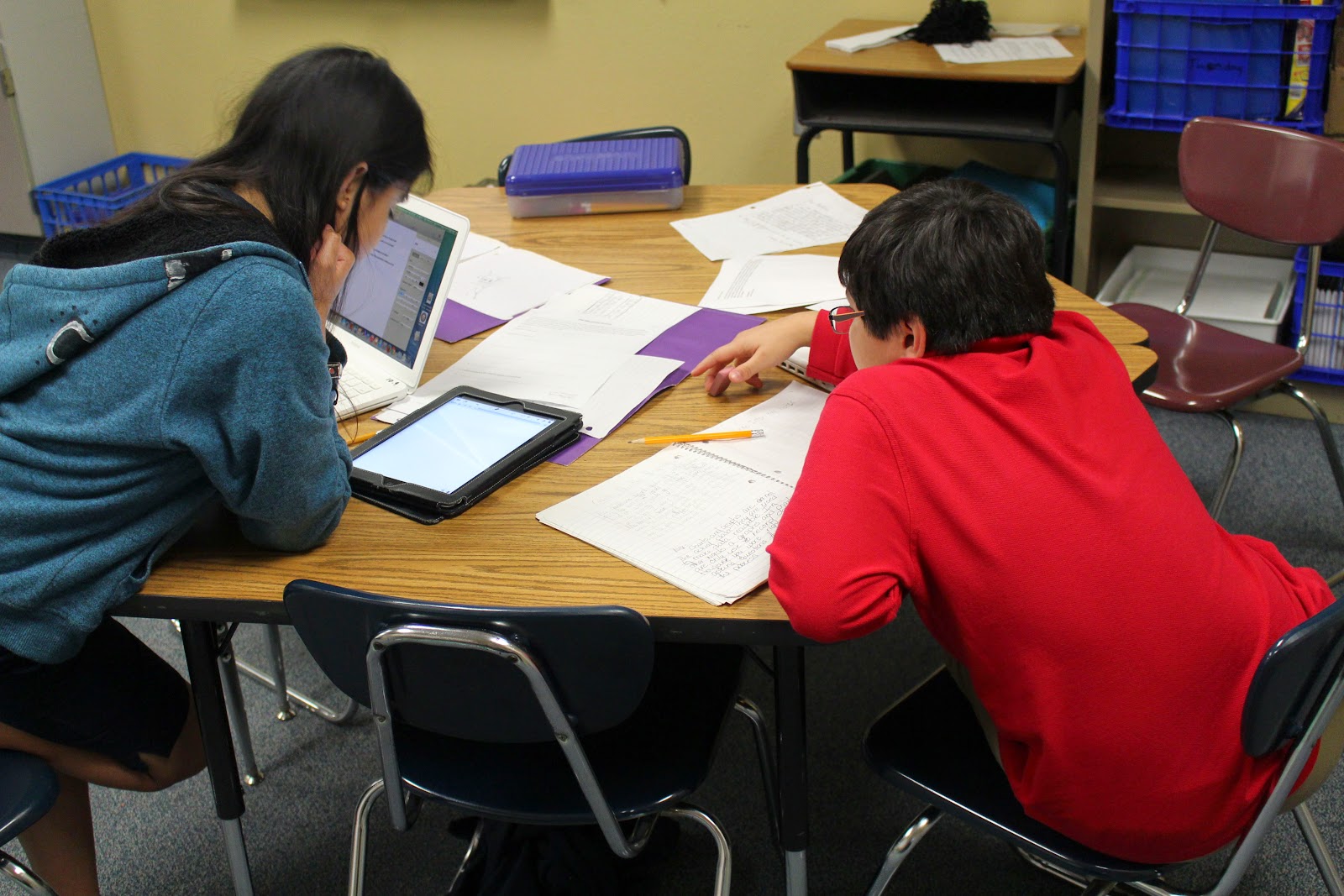
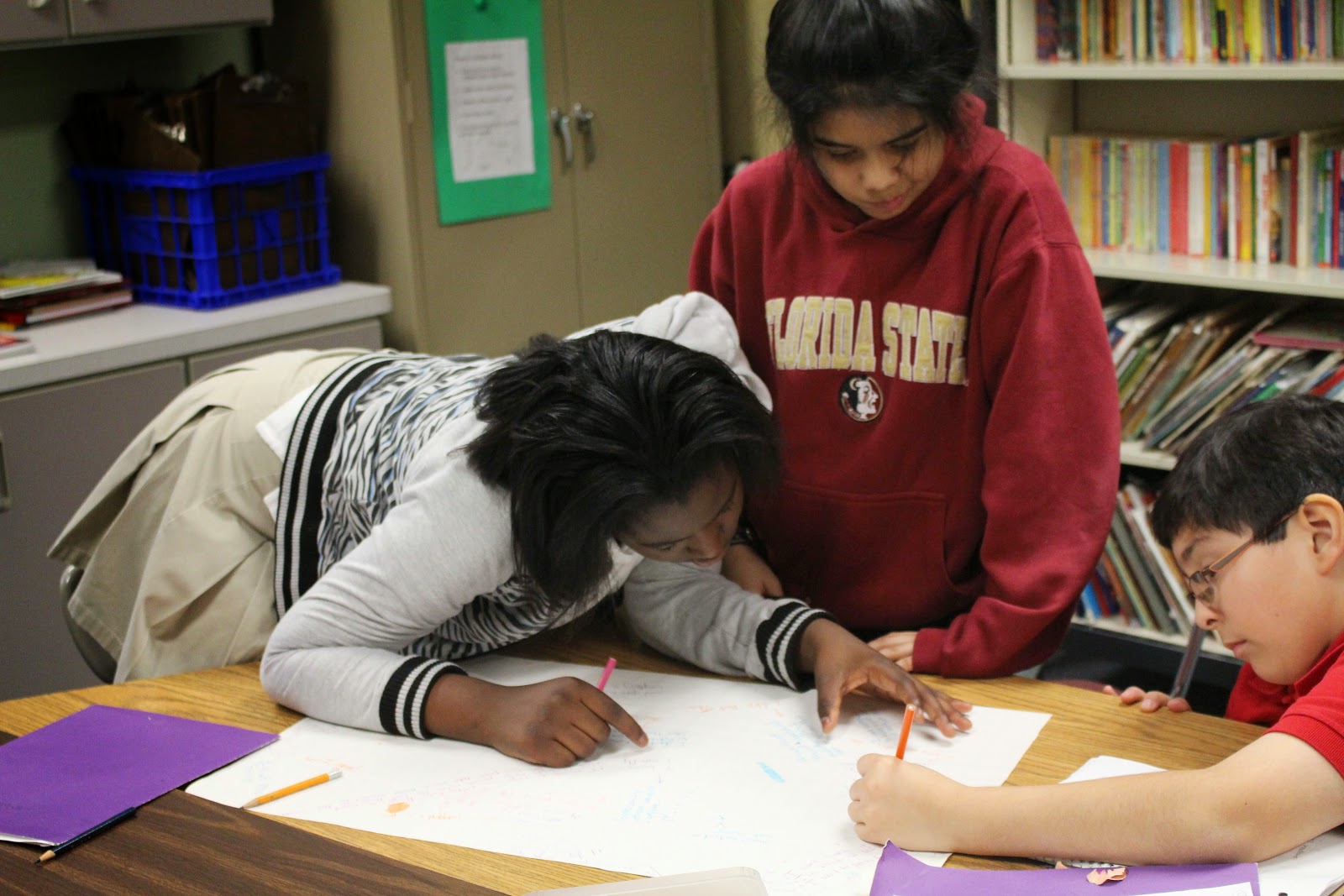
Just a few photos of my students working. 


Below are the students collecting information from their record interview using Notability. 


Friday, January 16, 2015

In the Process of CBL Spring 2015-Week 2


This week we worked on creating our Guiding Questions and planning out our investigations. At first, students were given ten minutes and asked to silently write down any questions they could think of in regards to their challenge. Students were asked to focus their questions on the following: where they are now, where they want to be, and who can help them get there. Students then worked together to combine, edit, refine and establish their group's Guiding Questions. 

Then students work together to create an Aha-Board for their group's Challenge. These boards work much like a web with the Challenge in the middle and the Guiding Questions on the outer edges. Leaving enough space between Guiding Questions for students to keep notes and activity that relate to each. These Aha-Boards are used to keep each group focused and at the same time creating some accountability within each group and beyond. 


As usual,  at the end of class we took the time to reflect about the part of the CBL process we worked on today.  Since much of our time was on questioning, my students were given the following prompt:  It is important to ask good questions, because___________ (Please use real life examples).


Links Mentioned
Challenge Based Learning 

How to Play Mancala

More on Aha-Boards

Friday, January 9, 2015

In the Process of CBL Spring 2015-Week 1


At the end of class, students were asked write in their Interactive Notebooks and explain why it is important for us to know the CBL Framework before we get started on our challenge. Here is what one fourth grader who entered the program after our challenge had begun wrote this:

I think we need to know about the CBL framework before we get started so that I know what to do and where my place is. An example, would be last year when we were suppose to be asking Guiding Questions I kept thinking we have our question and our challenge. Now I understand that the Guiding Questions are suppose to guide our research. It is going to be nice to know and understand where I am in the process this year. 

Here are a few shots I took of my students using the Chalk Talk routine to break down their Big Idea.


 Links Mentioned


In the Process of CBL Spring 2015-Introduction


Here is a link to more information on Challenge Based Learning (CBL).

Friday, September 5, 2014

Interactive Notebook and Challenge Based Learning #4 -(The Set Up)

     As I stated in my first post about Interactive Notebooks last year I mentioned that when I began the process of implementing them into our laboratory I was a bit overwhelmed. This is partly due to the fact that I am a global thinker and if I were completetly honest organization has never been my real strong suite. However, as we made our through our Challenge Based Learning (CBL) projects last year I saw the true value of the Interactive Notebooks were playing in that process. I had read some of the research on their effectiveness and heard testimonies. However, it wasn't until I began to see the effectiveness with my students that I became a true believer. With the limited implementation we did last year it was obvious that these interactive notebooks were aiding in guiding and promoting my students to own both their process and their thinking. It also became clear that for my students to continue to grow towards independence I was going to have to do some more work.

      In June, after the 2013-2014 dust settled a bit, my research on different ways teachers had set up interactive notebooks began. There is quite a bit out there; on Pintrest, blogs and You Tube. A lot of the information I found was very similar, which allowed me to then weed through items based on quality.  One of the best examples I found on setting up interactive notebooks was the following video.  It is clear, easy to follow, and I especially found the the split screen to be very effective. I truly hope Mr. Strohmeyer doesn't mind me highlighting his work here.


  For obvious reasons, as the 2014-15 school year began setting up our interactive notebooks was a top priority. We have methodically labeled the cover, wrote the rules on the inside flap, set up the table of contents and numbered all the pages. I would be lying if I did not admit that throughout the process there weren't some frustrations on all our parts when pages were numbered incorrectly and/or directions weren't followed exactly. However, that was accompanied with the knowledge that students throughout this year; will be more organized, have less lost work, and ultimately will spend more time on task due to these notebooks being set up properly. That to me is time well spent!


      This week students began their first research project and we did our best to set things up in our interactive notebooks for success. We first brainstormed on what skills they needed to complete a research project, we reviewed the project rubric, broke down seven pages with different graphic organizers to hold the information and then added those page numbers to the Table of Contents. During the first twenty minutes of our independent work time, I overheard a student say to another, "This is great now I know where to put my information so I can find it." Later that comment had me reflecting about the many times I had complained about students not keeping their work organized and/or feeling frustrated over work just being lost. Thoughts which lead me to a conclusion (although I hated to admit it) that I had indeed played a huge role in this issue. How could I have expect my students to exhibit what I had never modeled or taught them? A question I will need to keep on asking myself as we continue to move forward with interactive notebook. The reality is, we are all in the learning process here and to have a true community of learners I must continue to be the lead learner. With that said, I am just so thankful for those out there who continue to share the work they are doing with interactive notebooks, because this learner here is finding it all very helpful and enlightening.

Wednesday, April 30, 2014

Discovery Education Spring Virtcon and CBL

Last week I was honored to be contacted by Karen Ogen, who serves as Coordinator of Media/ Technology Magnet Program in Columbia, South Carolina, in regards to her Keynote presentation entitled "Igniting A Passion for Learning" for Discovery Education Spring VirtCon.  Her plan was to present several different avenues to inspire and challenge students in the classroom, which included Genius Hour, gamification, maker challenges and Challenge Based Learning (CBL). She then approached myself and other DEN Stars with the opportunity to share a bit about our experiences with these learning frameworks. I was sent few questions and asked to share about something I am truly passionate about, CBL. 

Since we all know that when people are truly passionate about something asking them to keep things brief is hard and due to her time constraints she had to cut everyone's section down some. However, I still had my video pieces on my computer  and I thought I would share the full version of my answers here for those still interested. 


Challenge Based Learning (CBL) Resources
https://www.challengebasedlearning.org/

iTunes U

Helpful Books
by Ron Ritchart, Mark Church and Karin Morrison

by Stephanie Harvey and Harvey Daniels

by Kellie Marcarelli
 

Friday, March 28, 2014

What is a Hero?- Our CBL Big Idea

This year in the Oneco's Gifted Laboratory have been exploring what it takes to be a hero/ heroine. From the very beginning, I felt that was important that we all have a clear definition of what qualities it takes to make a hero/heroine. 

Our first step this exploration began by pulling out heroes/heroines form a variety of different genres of literature. Students identified and recorded text evidence for the different character traits of each hero/heroine using a Frayer Model.  This graphic organizer is commonly used to define words and concepts. Our Frayer Model was divided into to four sections and served as a visual representation for students for what the character: looks like, thinks, says and does. This first step was done so that we could both get to know our character and compare and contrast the information later. 

  After, we have had time to read about several different heroes/heroines we will go back through our Frayer Models using the evidence recorded to  compare and contrast these traits and generate a master list of common hero attributes. Next we created a T-Chart with our master list of the common attributes on the right and room for text evidence on the left.


  After some practice with this graphic organizer with several more books students were asked to write and prove someone to be a hero or not. 

This hero study has brought about many wonderful discussions in our laboratory this year. It has also severed as the Big Idea of our Challenge Based Learning (CBL) Challenges, which is being heroes/heroines on Oneco’s Campus.

Monday, March 24, 2014

Challenge Based Learning - Measuring Our Solution #1

I thought others might find this helpful. These activities took about an hour and half.

Background
These activities were completed with a group of third graders in the midst of our Challenge Based Learning (CBL) Challenge: To encourage better cooperation at recess! Throughout this challenge students have participated in activities that have covered a multitude of the goals found in the Florida Framework for K-12 Gifted Learner and a variety of cross curriculum standards.


The main goal these activities will be:
Florida Framework Goal 4-C:
Use and evaluate various problem-solving methods to determine effectiveness in solving real-world problems.


LEQ:
1.  Why do you think it is important to measure the effectiveness of a solution or goal?
2.  Why do you think it is important to keep data while you are measuring something? 
3.  Can you create a plan to measure the solution to our recess challenge?

Materials:
-Ball
Two pieces of chart paper with questions in the middle for Chalk Talk
-Crayons for Chalk Talk
-Student each need their notebooks and reflection journals
-Chart paper to record


Procedures:
Brainstorming/Focus Activity (10-15 minutes-depending on prior knowledge):
-Pull students into a circle on the floor.
-Ball will be passed and students will take time to brainstorm and share answers to the following:
    What can be measure?
    How can it be measure?
    What tools are used to measure it? 


Chalk Talk 
(10 minutes)
-Take two pieces of chart paper each with a different question in the center.
-Place each in the center of a table. 
-Students will be broken into two groups, told to grab a colored pencil and sent to one of the tables with the chart paper. 
- Without speaking students will then respond directly on the paper to that question. Students are encourage to respond to other people's comments as well.  
-After five minutes the group switches tables and to repeat the process.
-Finally, we gather back together to discuss some of the students' responses found on each chart paper.

Question found on the pieces of chart paper:
 1.  Why do you think it is important to measure the effectiveness of a solution or goal?
2.  Why do you think it is important to keep data while you are measuring something? 


Quick Writes- (15 minutes)
10 minutes write/ 5 minutes discuss
Prompt:
What is measurement and why do people use it in everyday life? Share some examples.


Journal Entry Analyzing
-Students will pull out their journals entries they worked on last week.
 Last weeks prompt: What do you hope to see, hear and feel at recess after our campaign launches?
-Each student will read through his/her own entry and underline anything they believe they can collect data on. 
(Hint: You should be able to tell someone what data you will collect to measure that outcome.) 
-Students will then pair up and reread entries to make sure what is underlined can be measured. The only judgement made at this point will be is can what is underlined be measured. 
-They will then share entries in groups of three or four. These groups will then make a T-Chart with measurable outcomes on one side and how they can be measured on the other.
-Together we will consolidate the list as a whole group onto a piece chart paper using post its.
-We will review the list and discuss our options of evaluation based on time, manpower and access to information. 
-Based on that criteria we will choose at least two forms of measurement. Then develop and action plan to carry that evaluation. 


Students were then return to the Quick Writes prompt and complete their thoughts. This will serve as a reflection piece for today's lesson.  


Assessment:
Thiss process will be assessed using a Critical Thinking and Problem Rubric that I developed based (or modified) on the Florida Framework K-12 Gifted Learners Rubric.

Tuesday, February 18, 2014

Interactive Notebooks and Challenge Based Learning - #3 (The Aha Board)


In my first post on Interactive Notebooks and Challenge Based Learning I skimmed over the concept of The Aha Board.  In the book Teaching Science with Interactive Notebooks by Kellie Marcarelli she talks about these boards being used to hold the students' learning on the major concepts of each unit. We have modified this concept a bit to meet our needs within the process of  Challenge Based Learning (CBL) . What we have done is basically created an interactive challenge map or web. We have put the challenge in the middle and taken large Post -Its and wrote a Guiding Question on each. As students have made their way through their research they have written on smaller Post-Its the things they have learned and how they learned that under each Guiding Question.

    Oneco's Gifted Program has been working with CBL for about four years now and each year our process has become more and more refined. This would also included training students to take more ownership in the CBL process itself.  In the past, my students were able to effectively carry out CBL Challenges, but struggled to see where they were in the process especially in the Guiding Questions, Guiding Resources and Guiding Activities Components. Although, we had attempted to keep track of the process through packets and other such formats, these avenues had left us frustrated at times. It might have been that my elementary school students needed something a bit more concrete, maybe they feel more accountable now that the people entering our classroom can see their work in progress or they just enjoy putting Post-Its on the cabinet. My guess it a is combination of all those things and that is okay with me since The Aha-Boards effectiveness has certainly been AMAZING.  Since they have been introduced students have been using the evidence demonstrated on their group's board to discuss the quality of the research being done and what their next steps in the process should be. We were not seeing this type of metacognition before the Aha-Boards were introduced and my students have learn to depend on them.

Last week a few of my students and I were discussing the need to reflect on strategies that we use in hopes that they will become part of our learning toolbox. To prove my point, I pulled up my recent blog posts on our use of Interactive Notebooks and Challenge Based Learning. After reading my first post, these students turned on me a bit and wanted to know why I had just skimmed over The Aha-Boards. Honestly, they got just a little heated about my neglect in this matter.  Then these eight year olds went on to explain why they felt they were important, why we need them and why others should hear about them. I had to promise that within the next couple of weeks I would remedy the situation. I have done my best to cover everything we talked about in this post and I do hope I have done them proud. However, I promise if I missed something they will let me know. 

It is my hope to one day have these Aha-Boards go digital, but I truly felt that we need this concert model first.

Saturday, February 15, 2014

Interactive Notebooks and Challenge Based Learning - #2

In my last post I spoke about how we were  implementing Interactive Notebooks into our Challenge Based Learning (CBL) process so I thought spend some time demonstrating what this could look like in an elementary school classroom. This may turn into a series of post, but for now here is a lesson done with my second grade students in the midst of their CBL Challenge: To help keep Oneco Elementary School's Campus clean and beautiful

The strategies I present in this video have been taken and modified from Discovery Education's - Spotlight on Strategies (S.O.S) Blog. I was introduced to this incredible series about two months ago and it is quickly becoming one of my go to resources when dealing with multimedia.

 
Please make sure to watch all the way to the end to hear a couple of students discuss their metacognitive thinking. 


Here is the blank graphic organizer I use with my kindergarten and first graders. As we make our way through different videos we use Post-its in each section to hold our thoughts. 

Wednesday, February 12, 2014

Interactive Notebooks and Challenge Based Learning


The idea of Interactive Notebooks was a bit new to me this year and there has been a steep learning curve. Actually, this has been the piece I have been looking for awhile to round out our Challenge Based Learning (CBL) process. The CBL Framework gives us a great set of procedures. Then the Stephanie Harvey and Harvey Daniels' book Inquiry Circles in Action:Comprehension and Collaboration helps guide the mini-lessons that need to be taught during our process. However, for us it just seemed like there was still a piece missing in our process and I now believe that interactive notebooks maybe our answer. These notebooks are set up to  provide a way for students to document, keep track of, and reflect throughout their process.

I will admit by the end of the first quarter this year I found myself a bit overwhelm by the implementation of Interactive Notebooks. There was just so much information out there that I was having trouble focusing on exactly how to go about getting started. At that point, I decided to focus on the book Teaching Science with Interactive Notebooks by Kellie Marcarelli and then pull in other resources. I did this for several reasons:

1) The fact that The CBL Framework relates so closely to the scientific method. Some of my students spent time to compare and contrasting the two processes in this post Comparing and Contrasting CBL and The Scientific Method.

2) This book goes into the nuts and bolts of using interactive notebooks (hows and whys).

3) The fact the author based the procedures on the strategies described in the book Classroom Instruction that Works by Marzano, Pickering and Pollock and the procedures are research based. 

In the past, I thought and behaved as if it was my role to dictate what gets done when, but I have come to realize that way of teaching was hurting my students in the long run. My students were not being allowed to think for themselves or able to move to the next step in a CBL challenges (or really any activity) without me telling them what needed to be done. Truth is, if we want students to grow up to be independent problem solvers we are going to have to let go of the reigns some (even with procedures). With the Interactive Notebook, Aha Boards and task list my students are really gaining independence in these areas. As well as, improving the quality of their reflective thinking. This implementation is slowing down our CBL process, but I believe this is time well spent.

If you are interested in following along in our process you can find us here: 

Grade 3 - Tuesday

CBL Challenge: 
To encourage better cooperation at recess.  

Grade 4/5 - Thursday 

CBL Challenges:

The Thunder Katz: To work to improve morning snacks. 
Gummy Bears: To prevent and eliminate bullying on Oneco's Campus.  
Wolfpack: To promote students spending more time appreciating the nature on campus.